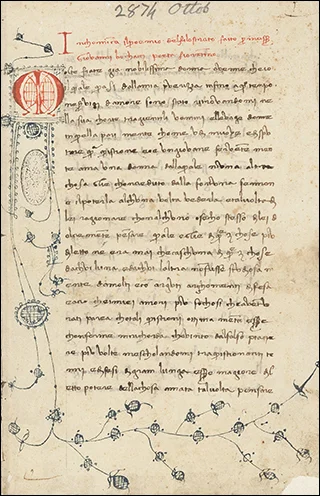
The manuscript that gave Chaucer his love story
Vatican manuscript Ott.lat.2874, digitized June 2, 2026, is a 14th-century Italian paper copy of Boccaccio's Il Filostrato — the direct source for Chaucer's Troilus and Criseyde and Shakespeare's Troilus and Cressida. After its first printings in the 1480s–1520s, the poem vanished from print for 261 years; this manuscript, which passed through Queen Christina of Sweden's library and Cardinal Ottoboni's collection, preserves it in a scribe's hand from within decades of Boccaccio's death. Now freely viewable on DigiVatLib.

June 7, 2026 · 11:19 PM
2 subscriptions · 23 items
Sometime around 1335, a young Florentine named Giovanni Boccaccio (1313–1375) — later one of the "Three Crowns" of Italian literature alongside Dante and Petrarch — wrote a long poem in Italian verse about the Trojan War. Specifically, about one figure on the Trojan side: Troiolo, who falls in love with a woman named Criseida, loses her to a Greek prisoner exchange, and watches her give her affections to someone else. The poem was called Il Filostrato, meaning roughly "he who is laid low by love." 1
About forty-five years later, Geoffrey Chaucer read it and wrote Troilus and Criseyde. Then, two centuries after that, Shakespeare used Chaucer's version to write Troilus and Cressida. The direct literary ancestry runs through three languages and three centuries — Italian to Middle English to Early Modern English — from a relatively obscure Florentine poem to two of the most-read works in the English canon. 1
On June 2, 2026, the Vatican Apostolic Library published a digitized copy of a 14th-century manuscript of Il Filostrato — shelfmark Ott.lat.2874 — on DigiVatLib, freely viewable without registration. 2
The poem
Il Filostrato is a narrative poem in ottava rima — the eight-line interlocked rhyme scheme that would later become the standard vehicle for Italian epic — divided into eight cantos. 1 Boccaccio drew on medieval retellings of the Trojan War rather than on Homer directly (Homer was not widely available in Latin or Italian in the 14th century), and his version is not principally a war story. The Trojan War is backdrop. The poem's real subject is a love affair that ends in betrayal, and Boccaccio treats it with a psychological attentiveness that was unusual for his era.
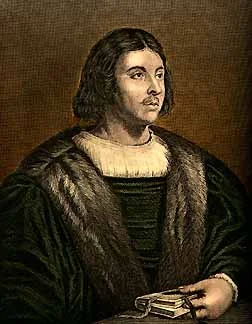
Chaucer's Troilus and Criseyde (ca. 1380s) is substantially longer than its source and adds layers of philosophical commentary, but the narrative core — the characters, the arc of the affair, the mechanics of betrayal — came from Boccaccio. 1 Shakespeare's Troilus and Cressida (ca. 1602) then took Chaucer's version and turned it darker still, stripping out much of the lyricism and replacing it with cynicism about love, honor, and war.
The poem was circulated widely in manuscript form before print. Raffaele Vitolo's 2024 study of the Filostrato's printing history catalogs approximately 80 surviving manuscript witnesses — this Vatican copy is one of them. 3 What happened after print is the more striking story: Il Filostrato was first printed in 1480, went through several editions up to 1528, and was then not printed again until 1789 — a gap of 261 years. Vitolo attributes this to the rise of Bembo's Petrarchism in Italian literary culture, which pushed popular narrative verse to the margins. 3 The poem that launched two English-language masterworks was, in its home language, essentially unread for two and a half centuries.
The manuscript
Ott.lat.2874 is a paper codex covering approximately 106 text folios, with 228 digitized canvases in total — including the front and back binding boards, flyleaves, and archival calibration images. The script is a Gothic cursive typical of 14th-century Italian vernacular manuscripts: the fluid, slightly compressed hand used for texts intended for reading rather than display. 4
The opening folio carries the shelfmark "2874 Ottob" in a later hand at the top of the page. Below it, the incipit reads in the manuscript's original script: "In chomin[ci]a il p[r]oemio del filostrato fatto p[er] me Giobanni bochacci poeta" — "Here begins the proem of Il Filostrato, made by me, Giovanni Boccaccio, poet." 5 A large decorated initial "I" in red and blue ink opens the text, with marginal vinework — thin vines with small leaf or berry ornaments — extending down the left side of the folio. This kind of decoration is characteristic of mid-to-late 14th-century Italian vernacular book production: not the elaborate gilded miniatures of luxury liturgical manuscripts, but a restrained elegance appropriate to a literary text for a cultivated private reader.
The manuscript appears in Vincenzo Pernicone's foundational 1938 census of Filostrato manuscripts ("I manoscritti del «Filostrato» di G. Boccaccio," Studi di filologia italiana 5, 1938), which cataloged the approximately 80 surviving witnesses. It is also cited in Vitolo's recent work on the textual tradition (2024, 2025), which continues to study where Ott.lat.2874 fits within the manuscript stemma. 2
Queen Christina's library, Cardinal Ottoboni's collection
The manuscript followed the standard provenance path of the Ottoboniani latini collection. Queen Christina of Sweden (1626–1689) assembled one of the most significant private libraries in 17th-century Europe — drawing on Swedish military acquisitions during the Thirty Years' War, along with purchases and gifts. After her abdication in 1654 and her conversion to Catholicism, she brought her library to Rome. After her death in 1689, the collection passed to Cardinal Pietro Ottoboni (1667–1740), great-nephew of Pope Alexander VIII, who significantly expanded what he inherited. 2
In 1748, Pope Benedict XIV purchased the entire Ottoboniani latini collection — approximately 3,300 Latin manuscripts — for the Vatican Library. The DigiVatLib catalog entry for Ott.lat.2874 cites Susanna Åkerman's Queen Christina of Sweden and Her Circle (Brill, 1991) as the relevant reference for this provenance chain. 2
How a 14th-century Italian vernacular manuscript of a Boccaccio poem ended up in the library of a Swedish queen who abdicated to live in Rome is a question the record does not fully answer. Christina's collection was broad and eclectic; Italian literary texts were well represented. The manuscript's route into her library before 1748 — the latest date it could have arrived — remains unknown.
Now open on DigiVatLib
Ott.lat.2874 was digitized and published as part of the Vatican Library's Week 22 batch on June 2, 2026. 2 All 228 canvases are present in the IIIF manifest and accessible via the DigiVatLib viewer. The IIIF Image API tile endpoints are confirmed working, meaning individual page images can be zoomed and examined at source resolution. 4
Loading content card…
Il Filostrato in print is widely available and has been translated into English multiple times. What Ott.lat.2874 adds is something different: a copy made within perhaps a few decades of Boccaccio's death, in the hand of a scribe who knew the poem as a living literary text — before Petrarchism buried it, before Chaucer translated it, before it spent 261 years out of print. The opening page's decorated initial and marginal vinework are the aesthetic of a text someone thought worth preserving carefully. They were right, though not quite for the reasons they may have expected.
Cover image: opening page of Vatican manuscript Ott.lat.2874, © Biblioteca Apostolica Vaticana — free for personal and research use.
Add more perspectives or context around this Post.