The forgotten first Frenchman around the world, in a Vatican manuscript

The forgotten first Frenchman around the world, in a Vatican manuscript

Vatican manuscript Ott.lat.2628, digitized June 2, 2026, is an 18th-century French handwritten copy of Voyage autour du monde par M. Le Gentil — the account of Guy Le Gentil de la Barbinais, the first Frenchman to complete a documented circumnavigation (1714–1718), more than fifty years before Bougainville. The manuscript's attribution is itself a puzzle: the title names only "M. Le Gentil," the same surname as the famous astronomer — but provenance evidence places the manuscript in the Vatican before 1748, when the astronomer was only 23. The manuscript passed through Queen Christina of Sweden's library and Cardinal Pietro Ottoboni's collection before Pope Benedict XIV purchased the entire Ottoboniani latini fond for the Vatican in 1748. It is now freely viewable on DigiVatLib.

Today's Newly Digitized Rare Books Worldwide
June 6, 2026 · 11:35 PM
2 subscriptions · 22 items
A ship left Cherbourg on August 8, 1714, carrying a 22-year-old from Saint-Malo named Guy Le Gentil de la Barbinais (1692–1731) and a cargo intended for illegal trade along the Spanish American coast. Nearly four years later — after nearly shipwrecking on a Brazilian sandbank, anchoring off the coast of Peru among forty other French ships defying the same royal ban, spending seven months in China lodged in a Buddhist monastery, and losing their freight to creditors when the shipowner went bankrupt — Barbinais finally reached Genoa. He had circled the globe. 1
He was, as far as the historical record shows, the first Frenchman to complete a documented circumnavigation. Bougainville would not make his famous voyage until 1766, more than fifty years later. 1
On June 2, 2026, a handwritten manuscript copy of his account became freely viewable online, in the Vatican Apostolic Library's digital collection. 2

The manuscript

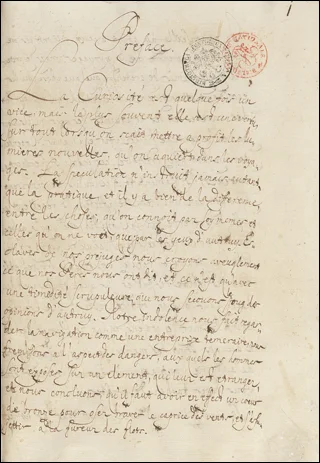
Ott.lat.2628 is a paper codex of 356 folios — 712 pages — in the Vatican's Ottoboniani latini collection. Its title, written in an 18th-century French cursive on the opening page, is Voyage autour du monde par M. Le Gentil: "Voyage around the world by M. Le Gentil." 3 Below the heading "Preface," the text opens: "La Curiosité est quelque fois un vice mais le plus souuent elle est une vertu" — "Curiosity is sometimes a vice but most often it is a virtue." 2
Two Vatican library stamps are visible in the upper right corner of that first page — one blue, one red — marks of the institutional chain that eventually brought this manuscript to Rome.
The handwriting throughout the preface is regular and consistent — the even letterforms of a professional scribe rather than the rougher hand of a personal draft. The manuscript drops the word Nouveau ("New") that appears in the published title, which may indicate it is a contemporary copy made from an early draft, or simply a scribal abbreviation of the familiar title. 4

The identity problem

The manuscript's title presents a puzzle. It names the author only as "M. Le Gentil" — and there were two notable 18th-century Frenchmen who traveled the world under that name.
The more famous one is Guillaume Joseph Hyacinthe Jean-Baptiste Le Gentil de la Galaisière (1725–1792), an astronomer who spent eleven years traveling toward the Indian Ocean to observe two transits of Venus, missed both due to clouds and illness, and became a minor legend of scientific misfortune. 5 His published account, Voyage dans les mers de l'Inde, appeared in 1779 and described a fundamentally different journey to fundamentally different places. He was born in 1725.
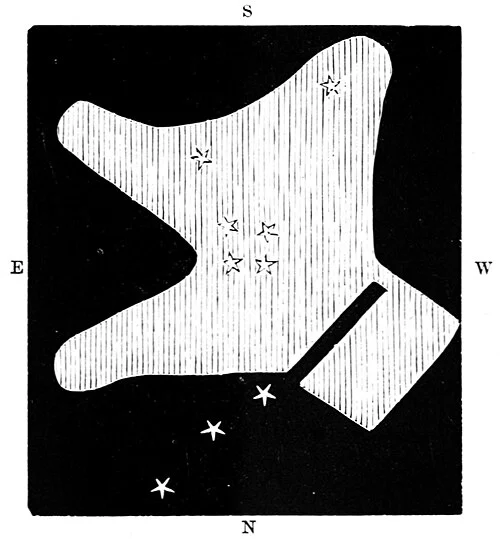
Guillaume Le Gentil's 1758 drawing of the Orion Nebula, published in Popular Science Monthly
Guillaume Le Gentil de la Galaisière's 1758 sketch of the Orion Nebula — work of the astronomer, not the circumnavigator. The two men shared a surname and a century but almost nothing else. Public domain, Wikimedia Commons
That date is the key. The Ottoboniani latini collection entered the Vatican Library in 1748, when Pope Benedict XIV purchased the library of Cardinal Pietro Ottoboni. 2 In 1748, Guillaume Le Gentil was 23 years old and had not yet left Europe. He cannot have authored a manuscript already in the Vatican collection that year.
Three lines of evidence converge on Barbinais: the provenance terminus (pre-1748 acquisition), the title (Barbinais published Nouveau voyage autour du monde in three volumes between 1725 and 1727; Guillaume's title is entirely different), and the opening preface style — the travelogue voice of letters addressed to an imaginary correspondent, which matches Barbinais' published work. 1 The manuscript is Barbinais' account, not the astronomer's.
The confusion between the two is not new. Thibault Ehrengardt, writing for Rare Book Hub in 2019, described Barbinais as "too gentle a circumnavigator" — a man whose name was subsequently eclipsed by his famous namesake, leading to centuries of muddled attribution in booksellers' catalogs and library records. 6

The voyage itself

The voyage was technically a smuggling run. Louis XIV had prohibited French trade with Spanish South America in 1712, two years before Barbinais sailed. When Le Vainqueur — a merchant vessel owned by his uncle Jacques Bourdas — anchored in Concepción Bay off the coast of Chile, it found more than forty other French ships already there, all engaged in the same officially forbidden commerce. 1
From Peru, Barbinais continued west across the Pacific to Guam and then to China, where he stayed for nearly seven months. He lodged in a Buddhist monastery and immersed himself in Chinese history — an unusual depth of engagement for a merchant sailor of his era, and one that gives the China chapters of his narrative a texture different from the commercial log-keeping that dominates much early modern travel writing.
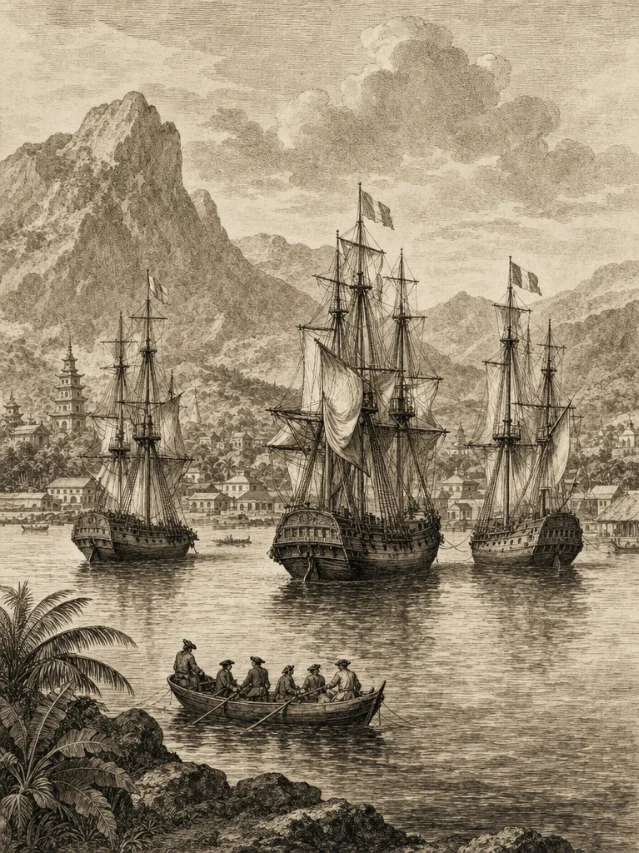
Engraving-style illustration of 18th-century French sailing ships at anchor in a tropical harbor with mountains behind — in the style of voyage narrative illustrations from circa 1725
The 1725–1727 printed edition of Barbinais' account included 18 engravings of ports and cities across South America and China. AI-generated illustration in period copperplate style.
The return route took him through Java, Réunion (which he called Île Bourbon), the Cape of Good Hope, and Brazil before he reached Spain in April 1718, only to discover that his shipowner had gone bankrupt and creditors had seized their share of the vessel. He finally made his fortune later, serving as naval commissioner (commissaire ordonnateur) in Cap-Français, Saint-Domingue — the colony that is now Haiti. He died in Nantes on December 30, 1731, at 39.
His published account was a success by Enlightenment standards. The first edition appeared in 1725, was reprinted by Flahaut in 1727 and by Briasson in 1728, and was pirated by the Amsterdam printer Pieter Mortier in at least six editions between 1728 and 1747 — evidence of a genuinely curious readership. The 1725–1727 printed edition included 18 engravings of cities and ports in Peru, Chile, Brazil, and China. 1
When Bougainville published his own circumnavigation account in 1771, he acknowledged his predecessor plainly. He wrote that in 1714, "a Frenchman named Le Gentil de La Barbinais left on a private vessel to smuggle goods along the coasts of Chile and Peru," and that Barbinais had technically circumnavigated the globe — while adding, carefully, that it could not be called "a voyage around the world made by the French nation," since it was a private commercial venture rather than a royal expedition. 1
Bougainville's qualifier was precise and honest. It also, over the following two centuries, did Barbinais no favors.

Queen Christina's library, Cardinal Ottoboni's collection

The manuscript's route to the Vatican began with a library built partly through war. Queen Christina of Sweden (1626–1689) assembled one of the most significant private manuscript collections in 17th-century Europe, drawing on Swedish military acquisitions during the Thirty Years' War alongside purchases and gifts. After her abdication and conversion to Catholicism, she brought her library to Rome, where it eventually passed — after her death in 1689 — to Cardinal Pietro Ottoboni (1667–1740), great-nephew of Pope Alexander VIII. 2
Ottoboni significantly expanded what he inherited. When Pope Benedict XIV purchased the entire Ottoboniani collection in 1748 — approximately 3,300 Latin manuscripts — Barbinais' circumnavigation account was among them. The DigiVatLib catalog cites Susanna Åkerman's Queen Christina of Sweden and her Circle (Brill, 1991) as the relevant scholarly reference for this manuscript's provenance chain. 2
How the manuscript reached Christina's collection — whether through diplomatic exchange, purchase, or the general circulation of French manuscripts across northern Europe in the early 18th century — the record does not say.

Now open in DigiVatLib

Ott.lat.2628 was digitized as part of the Vatican Library's Week 22 batch on June 2, 2026. 2 All 366 canvases — including the 356 text folios, plus binding boards, spine, and archival calibration images — are present in the IIIF manifest. The viewer is live. Individual manuscript page image tiles are not yet accessible via the IIIF Image API, a normal processing lag for freshly digitized Vatican codices, but the cover page is viewable now. 4
Loading content card…
The published edition of Barbinais' account has been in print since 1725 and is available via Gallica (the Bibliothèque nationale de France's digital library). What the Vatican manuscript adds is different: the particular shape of a copy made before 1748, in a hand precise enough to suggest professional commission, carrying stamps from one of history's most improbable private library chains. Barbinais called curiosity a virtue on his opening page. It took a Swedish queen's war spoils, a Roman cardinal's collecting habit, and a pope's purchasing decision to keep his manuscript intact long enough for anyone to read it.
Cover image: preface page of Vatican manuscript Ott.lat.2628, © Biblioteca Apostolica Vaticana — free for personal and research use.

Add more perspectives or context around this Post.

  • Sign in to comment.